Screen-Free Activities for Kids at Home in Pakistan
The hardest time to suggest an activity is 6:30 pm, when dinner is late, the weather outside is unpleasant and a child has already asked for the phone four times. “Do a puzzle” sounds sensible on paper. In the room, it may earn a blank stare.
Useful screen-free activities for kids need low setup, a clear starting point and permission to end before they become a family project. Some days that means twenty minutes with building tiles. Some days it means moving socks from one basket to another while you cook.
I do not treat screens as poison. Video calls, schoolwork and a good programme watched together have a place. The problem begins when the device becomes the only reliable answer to boredom.
Why screen-free play matters without turning it into a lecture
The American Academy of Pediatrics encourages families to protect time for sleep, movement, reading, play and face-to-face connection. Its current guidance on helping children thrive in a digital world recommends screen-free times and zones rather than pretending digital media can disappear from family life.
Play gives children room to make decisions. A tower falls and the child changes the base. A drawing looks wrong and becomes a monster. A card game forces everyone to wait for a turn.
The result does not need to be educational in the school sense. The American Academy of Pediatrics’ discussion of the power of play connects play with language, relationships, movement and problem-solving. The adult’s attention often matters more than the product.
Screen-free activities for kids that work in real homes
1. The ten-minute drawing invitation
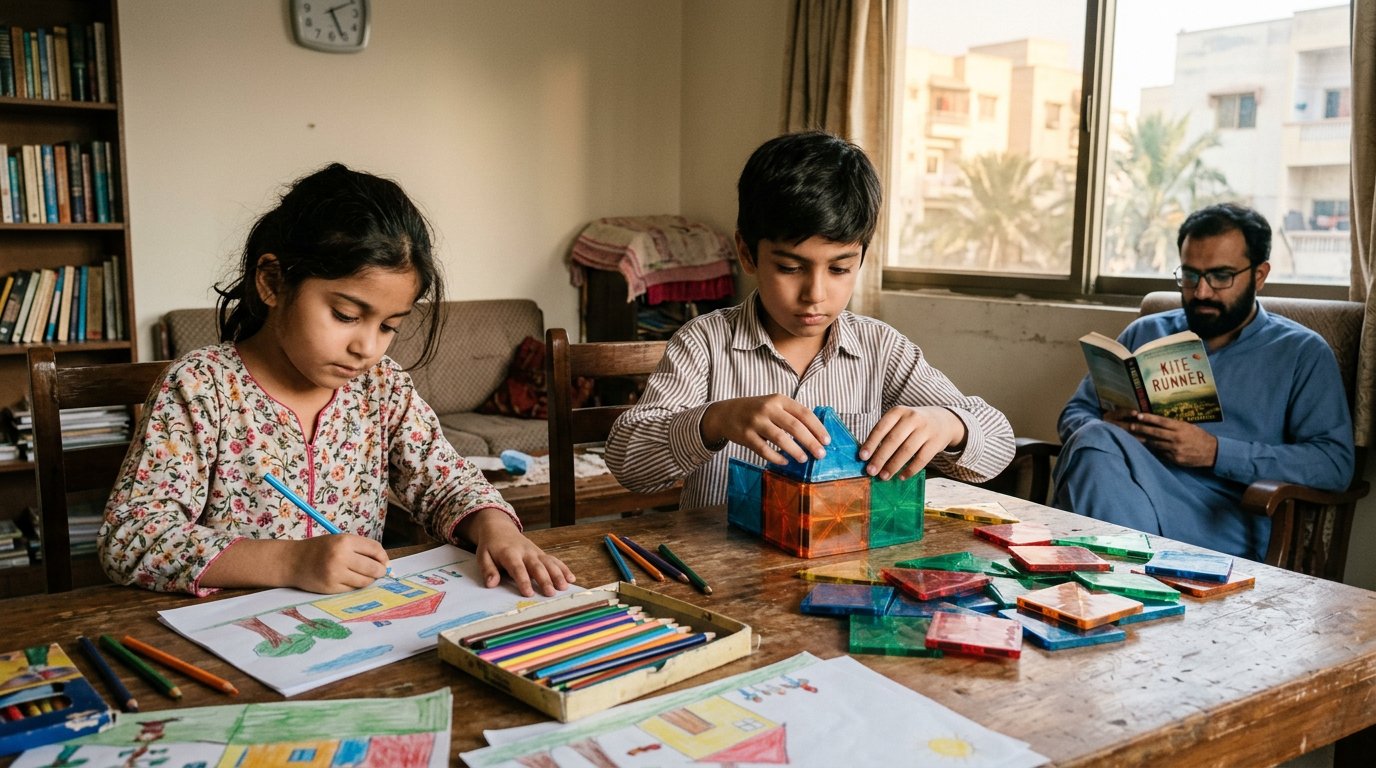
Do not announce “art time” and bring out forty supplies. Place paper and three colours on the table. Draw one odd shape yourself, then ask what it could become.
The Kids Art & Craft Supplies Kit is Rs. 1,599 and gives more variety when a child already enjoys drawing. Keep only a few tools out at once. A full open case can lead to cap loss and dried markers before the first picture is finished.
2. Build the tallest tower that can hold a spoon
This small challenge changes ordinary block play. Use building pieces, plastic cups or small boxes. The spoon adds a purpose without requiring a printed instruction sheet.
The Magnetic Building Tiles 32-Piece Set costs Rs. 1,699 and is tagged for ages 3–8. Thirty-two pieces are enough for small structures, not a giant castle. Check every tile for cracks and stop using any damaged magnetic piece.
3. Sock sorting while laundry is happening
Ask a toddler to find two socks that look alike. An older child can sort by owner, colour or size. This is free, useful and easy to abandon when attention moves elsewhere.
It is also closer to practical life than many expensive “sorting” toys.
4. Indoor tape roads
Use painter’s tape or masking tape to make roads on the floor. Add turns, parking spaces and a bridge made from a book. Remove the tape after play and test a small area first so the floor finish is not damaged.
This works well with existing cars. No new purchase required.
5. Family Jenga with a calmer rule
The Classic Wooden Jenga Stacking Game is Rs. 799. For younger players, remove the competitive ending. Build together, take one block at a time and laugh when it falls.
The original game rewards patience and hand control, but a tall collapse can upset a child who dislikes losing. Cooperative play is not cheating.
6. Texture hunt
Ask the child to find something smooth, rough, soft and bumpy in one room. Set boundaries: no kitchen drawers, no electrical items, no climbing.
For toddlers, a Sensory Play Kit for ages 1–3 can keep the textures contained. The 0–3 toy buying guide gives more context on matching sensory activities to a child’s current stage. It is listed at Rs. 1,199. Confirm piece size and supervise children who still mouth objects.
7. Water transfer on the balcony or bathroom floor
Two bowls, a cup and a cloth are enough. The child transfers water and wipes spills. Use a small amount, supervise continuously and choose a surface that will not become dangerously slippery.
This activity is better on a hot afternoon than in the middle of a cold Lahore January.
8. A five-item memory tray
Place five familiar objects on a tray. Let the child look, cover them, remove one and ask what is missing. Start with three items for younger children.
Do not turn it into a test. If the child keeps lifting the cloth early, that may be the game today.
9. Fastener practice before going out
A real shoe, zip bag and old jacket can provide useful practice. If you want the actions together, the Montessori Busy Board for Toddlers costs Rs. 1,799 and includes multiple practical fasteners.
The board is heavier than a cloth travel toy and contains mounted components. Inspect fasteners and supervise younger toddlers.
10. Story-building with three objects
Pick three unrelated household-safe objects: a spoon, a toy animal and a sock. Make up the first sentence, then let the child add the next event.
This often works better than asking, “Tell me a story,” which is too open for some children.
11. Balloon-free indoor bowling
Use empty plastic bottles and a soft ball or rolled socks. Avoid balloons around very young children because fragments can become a choking risk.
Count the fallen bottles, rearrange them and let the child set the distance.
12. Card sorting by a rule the child invents
Use flashcards, old greeting cards or safe magazine pictures. Sort by animal/not animal, red/not red, big/small or a rule the child makes up.
An invented rule can look illogical to an adult. Ask for the explanation before correcting it.
13. Paper bridge challenge
Give an older child paper, two books and a small toy. The goal is to make a bridge that holds the toy without taping it to the books. Folded paper is surprisingly strong.
This is a good reminder that STEM play does not require a branded kit every time.
14. Ten-minute tidy race without a winner
Choose one category—blocks, books or clothes—and set a timer. The family works together rather than competing over who cleaned more.
A reward chart can help some children, but I would not attach a sticker to every basic act. The routine should eventually make sense without constant prizes.
15. Evening family walk with a noticing game
Look for three blue objects, two birds, one round sign or a tree taller than a house. In summer, shift the walk later. During poor air quality, extreme heat or unsafe conditions, use an indoor movement game instead.
The CDC says children aged 3–5 should be active throughout the day, with caregivers encouraging active play. Its child activity guidance is a useful counterweight to screen-free lists that involve only sitting at a table.
Match the activity to the moment
| Situation | Low-setup activity | Useful item | Time needed |
|---|---|---|---|
| Parent is cooking | Sock sorting or memory tray | Household objects | 10–15 minutes |
| Hot afternoon indoors | Water transfer or art | Bowls or art kit | 15–30 minutes |
| Siblings need a shared game | Cooperative Jenga | Wooden stacking game | 15 minutes |
| Toddler wants switches and zips | Fastener practice | Busy board or old bag | 10–20 minutes |
| Child has building energy | Spoon tower challenge | Cups, boxes or tiles | 20–40 minutes |
| Everyone needs movement | Indoor bowling or walk | Soft ball or rolled socks | 15–30 minutes |
Do not buy your way out of every bored moment
A new toy can restart attention, but constant novelty teaches the family to answer boredom with shopping. Rotate what you already own.
Place four or five activities where the child can reach them. Store the rest. Bring one back after a week or two. The toy often feels new because the child has changed, not because the product has.
Browse the Montessori Learning collection when you genuinely need a matching, stacking or practical-life activity. Do not use the category as a weekly prescription.
I have found that one clear invitation works better than asking a child to choose from an entire cupboard. “Build a bed for this dinosaur” gets a response. “Go play with your toys” often does not.
Pakistan-specific practical notes
Electricity interruptions, limited outdoor space, heat and air quality can all affect family routines. Keep a small no-power activity box with paper, pencils, cards, a family game and a few building pieces.
For online orders, KidsTown currently lists 2–5 working-day delivery, Rs. 250 standard shipping, free delivery from Rs. 4,000 and COD. Order before the school break begins if the activity is meant for a specific week.
Ask for dimensions. A “large art set” may contain many pieces but still fit in a compact case. A building set may look generous in a close photograph and feel smaller when delivered.
Frequently asked questions
What are easy screen-free activities for kids at home?
Drawing with limited supplies, sock sorting, indoor bowling, a memory tray, tape roads and story-building with household objects all need little setup.
How do I reduce screen time without daily arguments?
Start with one predictable screen-free period, such as meals or the hour before bed. Offer a specific alternative rather than saying only “no phone.” Adults should follow the same rule where possible.
What screen-free activities work during summer in Pakistan?
Choose indoor building, art, water transfer in a safe area, family games and evening walks after temperatures drop. Avoid unsafe heat and check local air conditions.
Are educational toys necessary for screen-free play?
No. Household sorting, drawing, reading, outdoor observation and pretend play can be equally useful. A toy helps when it provides a durable activity the child will repeat.
Which screen-free toy is good for siblings?
Family Jenga, art materials and building tiles can support shared play, depending on age. Watch small parts around younger siblings and adjust competitive rules.
How long should a child stay with one activity?
There is no required duration. Ten focused minutes can be worthwhile. End before the activity becomes a struggle and try again another day.
Pick tomorrow’s activity tonight
Choose one idea and place the materials where you will actually use them. Do not prepare fifteen stations. If you need a product, select it for a specific activity—building, art, sensory play or fasteners—and ask for exact details before ordering.
Prices and availability were checked on 12 July 2026. Inspect products on delivery and confirm age suitability before use.