
Montessori Toys Pakistan: What to Buy (With Prices) | COD
Put a rainbow on a wooden toy, photograph it beside a beige rug, and somebody will call it Montessori. That does not make it so.
Parents searching for Montessori toys in Pakistan now see the label on puzzles, kitchen sets, flashcards, electronic tablets and even battery cars. Parents shopping specifically for ages 0–3 can compare developmental stages in the best toys for toddlers in Pakistan guide. The word has become a visual style as much as an educational idea. Some products still fit the principles well. Others are ordinary toys wearing neutral colours and a higher price.
I use a blunt test: Does the toy give the child a clear, hands-on task that can be repeated with less adult help over time? If the answer is no, the Montessori label is probably doing more work than the product.
Montessori is an approach, not a material
Maria Montessori’s work focused on independence, purposeful activity, order, concentration and a carefully prepared environment. Wood is common in Montessori classrooms because it is durable, tactile and stable. It is not compulsory.
A plastic cup can support independent pouring. A wooden toy with flashing lights and six unrelated buttons may not support focused activity at all.
The American Montessori Society describes early-childhood environments as including Practical Life, Sensorial, Language, Mathematics and cultural work. Its discussion of developmental periods and sensorial materials explains how handling materials can refine movement, perception and concentration while the child practises independence.
That does not mean every home needs classroom equipment. Most families need a small number of useful activities, space to repeat them and an adult who knows when to step back.
What makes a toy Montessori-aligned?
It has a clear purpose
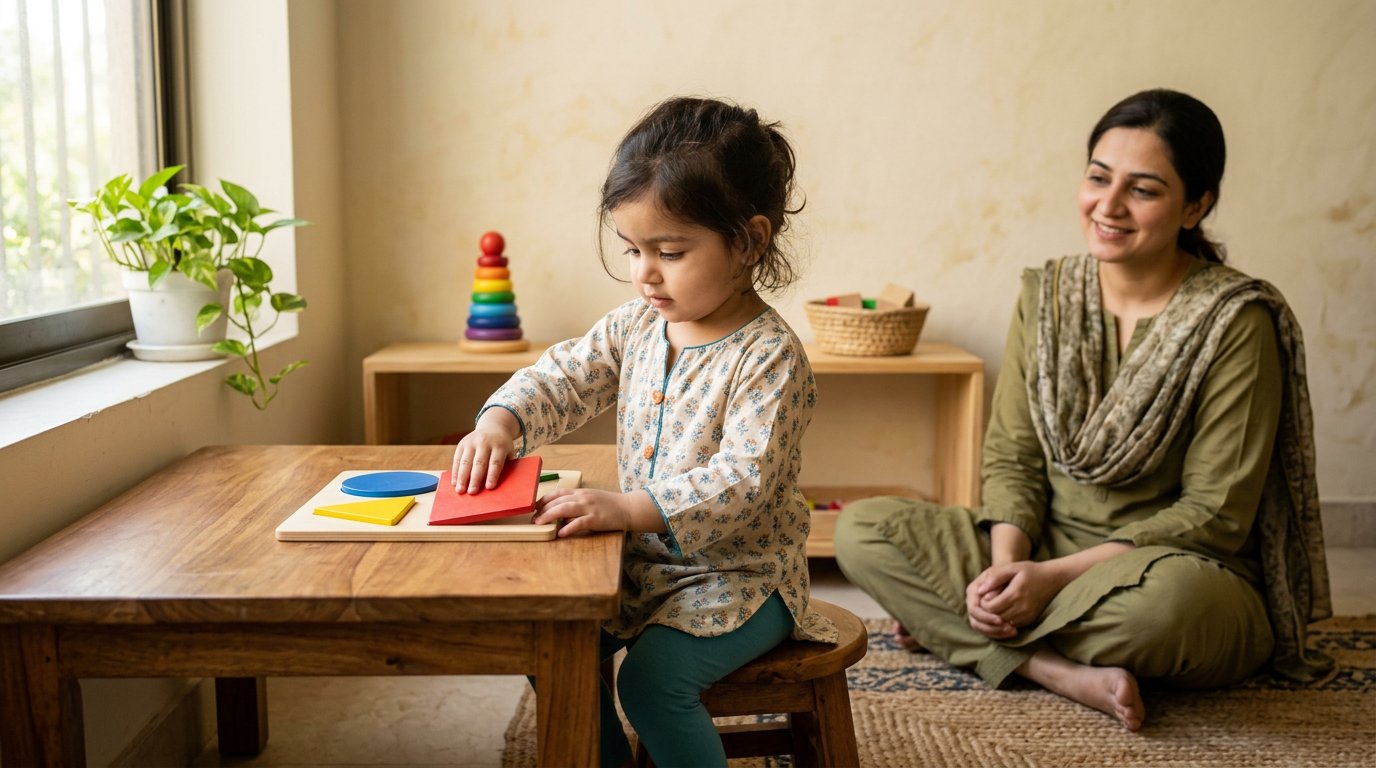
A shape sorter asks the child to match form and opening. A latch board asks the child to open and close a mechanism. The task is understandable from the object itself.
It invites hands-on repetition
The child can repeat the action without waiting for a new screen, song or instruction. Repetition is not wasted time. It is how control becomes smoother.
The child can become more independent
A good activity does not require an adult to reset a complicated game after every turn. The child gradually manages more of the process.
It limits unnecessary distraction
A single-purpose puzzle may hold attention better than a toy that lights up, talks, spins and asks quiz questions simultaneously.
It offers some control of error
With a shape sorter, the wrong piece does not fit. With size grading, an incorrect order looks or feels wrong. The material gives feedback without an adult saying “no” every few seconds.
What Montessori toys do not need to be
They do not need to be expensive.
They do not need to be imported.
They do not need to be wood, although wooden Montessori toys can be pleasant and durable when finished properly.
They do not need to promise early reading, genius-level logic or school admission advantages. Those claims make me more cautious, not less.
The American Montessori Society also recommends a simpler environment and toy rotation rather than keeping everything available at once. Its guide on the importance of a simple environment suggests that reducing visible toys can support concentration, cleanup and independence.
Montessori vs regular toys
The distinction is not moral. Regular pretend-play toys, dolls, vehicles and art materials can be excellent. A child does not need to spend the whole day matching cylinders in silence.
| Question | Montessori-aligned toy | Many conventional toys |
|---|---|---|
| Who drives the activity? | Mostly the child | Sometimes the toy’s sound, screen or script |
| Is there one clear skill? | Often yes | May combine many features |
| Can it be repeated independently? | Usually | Depends on batteries, rules or adult setup |
| Is imagination involved? | Sometimes structured, sometimes open-ended | Often strong in pretend play |
| Is wood required? | No | No |
| Is one type always better? | No | No |
A wooden rainbow is open-ended. A shape sorter is more self-correcting. A dollhouse supports symbolic play. They serve different purposes.
Five Montessori toys in Pakistan worth comparing
The prices below were checked on KidsTown at the time of writing. They may change.
1. Montessori Busy Board: practical fasteners
The Montessori Busy Board for Toddlers costs Rs. 1,799. It brings zips, buttons, laces, buckles, switches and other fasteners together on a wooden board.
Why it fits: the actions relate to real life and can be repeated. It may appeal to a toddler who already tries to open bags or fasten shoes.
Trade-off: there are many mounted components. Check the fasteners regularly, supervise younger children and do not assume that “Montessori” replaces safety inspection.
2. Wooden Shape Sorter Cube: visible feedback
The Wooden Shape Sorter Cube is Rs. 999. Matching a shape to its opening gives the child immediate feedback.
Why it fits: the task is concrete and progressively manageable. Early play may simply involve removing pieces; accurate matching comes later.
Trade-off: piece size and paint finish matter for young toddlers. Ask for scale information when the photographs are unclear.
3. Wooden Rainbow Stacker: open-ended construction
The Wooden Rainbow Stacking Toy costs Rs. 1,199 and contains seven arches. Children can stack, nest, balance or use the pieces as tunnels and bridges.
Why it fits: there is no electronic reward and no single finished result. It can move from simple nesting to imaginative building.
Trade-off: “hundreds of ways to play” sounds attractive, but some children prefer a clearer task. If your toddler gets frustrated by open-ended materials, a shape sorter may work better first.
4. Carrot Harvest Sorting Game: size discrimination
The Montessori Wooden Carrot Harvest Sorting Game is listed at Rs. 1,499. Seven carrot pieces fit into different openings in a wooden block.
Why it fits: the child compares size and tests where each piece belongs. The action is simple enough to repeat.
Trade-off: inspect the smallest carrot, the paint and the drilled holes. A product can be educational and still need supervision.
5. Lock and Key Sensory Board: real mechanisms
The Montessori Wooden Lock & Key Sensory Board costs Rs. 2,199. It uses several metal latch styles mounted on wood.
Why it fits: it turns the child’s interest in household locks into a contained practical-life activity. Opening a bolt or clasp gives obvious feedback.
Trade-off: it is the most expensive option in this comparison and includes metal hardware. Inspect mounting points and possible pinch areas.
Browse the full Montessori Learning collection if you want to compare simpler puzzles, stacking activities and sensory products before choosing.
Age, skill and price comparison
| Approximate age | Product | Main skill | Current price |
|---|---|---|---|
| 1–3 years | Wooden Shape Sorter Cube | Shape matching and hand-eye coordination | Rs. 999 |
| 1–3 years | Wooden Rainbow Stacker | Balance and open-ended construction | Rs. 1,199 |
| 1–3 years | Carrot Harvest Sorting Game | Size discrimination and posting | Rs. 1,499 |
| 1–3 years | Montessori Busy Board | Fasteners and practical hand skills | Rs. 1,799 |
| 1–3 years | Lock & Key Sensory Board | Latches, sequencing and finger control | Rs. 2,199 |
These age ranges come from current product tags. Your child’s mouthing behaviour, coordination and supervision needs matter more than the table.
Which products are mostly marketing?
Be cautious when a listing calls something Montessori but the product:
- Relies mainly on lights, songs or automated questions
- Has no clear hands-on purpose
- Shows many unrelated activities packed together
- Promises unrealistic academic results
- Uses “wooden” as the only explanation
- Cannot be reset or repeated by the child
- Is too complicated for the stated age
- Has tiny pieces while being marketed to toddlers
Flashcards are a good example of context. Cards can support language when an adult talks naturally with a child. A thick stack of cards is not automatically Montessori, and drilling a bored two-year-old is not independence.
How to set up Montessori activities at home
You do not need a dedicated playroom.
Keep the selection small
Place three to five activities where the child can see and reach them safely. Store the rest. A crowded shelf makes each object less visible.
Use a consistent place
A low shelf, basket or mat helps define where pieces belong. Order is part of the experience, but the house does not need to look perfect.
Demonstrate slowly, then stop
Show one complete cycle with minimal talking. Then allow the child to try. Correcting every movement can turn independent work into a performance for the adult.
I have to remind myself of this during product evaluation too. It is tempting to demonstrate every feature because the product has many. The child may only need one zip today.
Rotate instead of adding
When an activity is ignored for several days, store it and bring back something different. A toy can become interesting again after a break.
Include real household activity
Pouring water, wiping a table, sorting socks and carrying a small basket can be more Montessori-aligned than an expensive branded set. Toys should support family life, not replace it.
Pakistan price and quality context
At local markets, simple wooden puzzles may cost less than online versions. The finish can vary considerably between two pieces that look identical from a distance. Inspect for splinters, paint transfer, weak glue and warped bases.
Online, the comparison is easier but physical inspection comes later. Ask for:
- Exact dimensions
- Current product video
- Packaging photograph
- Material information
- Number of pieces
- Age label
- Return terms
KidsTown currently offers COD, Rs. 250 standard delivery, free shipping from Rs. 4,000 and an estimated 2–5 working-day delivery window. Product pages include a WhatsApp link for requesting real-product details.
The online price may be higher than a loose market piece. Part of that difference should buy you better information, support and a usable return process. If it does not, the premium is hard to justify.
One good activity is enough to start
For a child just beginning to match shapes, buy the shape sorter before a complicated activity wall. For a toddler fascinated by zips and locks, choose a fastener board. For a child who builds tunnels with household boxes, the rainbow stacker may have more lasting value.
I would rather see one well-used Rs. 999 toy than five “educational” products still tied to their packaging.
Frequently asked questions
What are Montessori toys?
They are materials or toys that support purposeful, hands-on activity, repetition, concentration and growing independence. “Montessori” is an educational approach, not a safety or material certification.
Are all wooden toys Montessori?
No. Wood is common because it is tactile and durable, but a toy’s purpose and the way the child uses it matter more than its colour or material.
What is the best Montessori toy for a 2-year-old in Pakistan?
It depends on the child’s current interest. Shape sorters suit matching, busy boards suit fasteners, and stacking toys suit balance and construction. Confirm piece size and supervise appropriately.
Are Montessori toys worth the higher price?
Some are, particularly durable activities that can be repeated for several years. A higher price is not justified by beige paint or the Montessori label alone. Compare material, construction and actual use.
Can Montessori toys help speech development?
A toy may create opportunities for conversation—naming shapes, describing texture or talking through an action—but it does not replace responsive interaction or professional advice for speech concerns.
Where can I buy Montessori toys online in Pakistan?
Specialist toy stores and larger marketplaces carry them. Compare age labels, materials, dimensions, real photographs, COD terms and return policies rather than choosing by the Montessori keyword alone.
Choose the task, not the trend
Start with the action your child is ready to practise: matching, stacking, fastening, sorting or building. Then choose the simplest well-made product that supports it. If the listing leaves out size, material or packaging details, ask before ordering.
Prices and availability were checked on 12 July 2026. Product suitability depends on the individual child; inspect every toy before use.
Common Questions
How is a Montessori toy different from a regular toy?
Montessori materials teach exactly ONE skill precisely (grip, size ordering, counting) with self-correction built in - the child sees their own mistake. Regular toys often do ten flashy things and teach nothing deeply.
Do I need a full Montessori setup at home?
No - four or five core materials rotated weekly beat a room full of toys: a stacker, a knob puzzle, a shape sorter, a counting shelf and one practical-life item cover 80% of the early curriculum.
Which Montessori toy should I buy first in Pakistan?
For 1.5-3 years: the rainbow ring stacker. For 3-4: a knob puzzle set. For 4-6: an abacus or calculation shelf. All three are in stock with COD on KidsTown.pk.

One Comment